



- This event has passed.
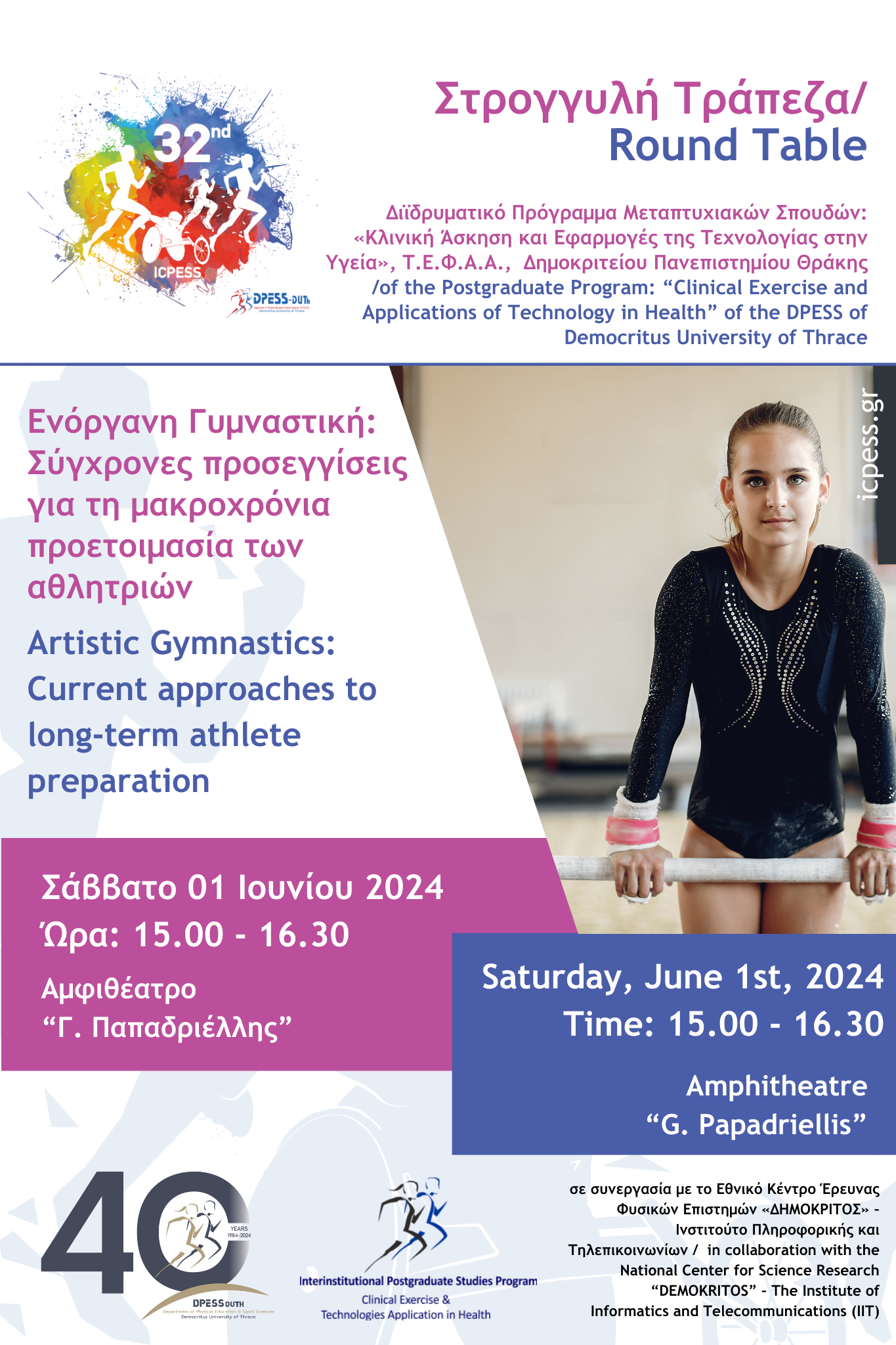
Artistic Gymnastics: Current approaches to long-term athlete preparation
Inter-Institutional Postgraduate Program: “Clinical Exercise and Applications of Technology in Health”
of the Department of Physical Education and Sport of the School of Physical Education and Sport Science of Democritus University of Thrace in collaboration with the National Center for Science Research “DEMOKRITOS” – The Institute of Informatics and Telecommunications (IIT)
Saturday, 1 June, 2024
15:00 – 16:30
Amphitheatre ‘’G. Papadriellis’’
ROUND TABLE
Artistic Gymnastics: Current approaches to long-term athlete preparation
Chair: Helen Douda, Professor, D.P.E.S.S., Democritus University of Thrace
Director of the Inter-institutional Postgraduate Program: “Clinical Exercise and Applications of Technology in Health”
Paschalis Kirialanis, Associate Professor, D.P.E.S.S., Democritus University of Thrace
Speakers:
Training load and injury in women’s Artistic Gymnastics: Causes and future directions
Anastasia Donti, Special Teaching Staff, School of Physical Education and Sport Science, National and Kapodistrian University of Athens, Greece, Coach / Hellenic Gymnastics Federation, International Gymnastics Federation Judge / International Gymnastics Federation
Long-term planning for physical fitness development in women’s artistic gymnastics
Olyvia Donti, Associate Professor, School of Physical Education and Sport Science, National and Kapodistrian University of Athens, Greece
International Gymnastics Federation Judge / International Gymnastics Federation
The Gymnastics Coach Today: A multifaceted task
Dimosthenis Tampakos, Olympic Gold and Silver Medalist, Lieutenant Colonel (A), MSc in School Physical Education, Department of Physical Education and Sport Science, Aristotle University of Thessaloniki
Abstract
Training load and injury in women’s Artistic Gymnastics: Causes and future directions
A high injury rate is reported in Women’s Artistic Gymnastics, from a young age. Gymnasts aged 10–12 and 13–17 years have an increased risk of injury compared with younger or older gymnasts. The most common injuries observed are acute (65%) while approximately 35% are chronic injuries. Lower limb injuries are the most prevalent acute injuries, followed by upper limb and spinal injuries. The symptoms of chronic injuries (usually overuse injuries) develop gradually over time, heal quickly in children but may appear later in future, affecting athletes’ health and performance. Injury risk nature is multifactorial, and often the causes between acute and chronic injuries are different. This presentation will focus on high training load, insufficient time for recovery and biological adaptations, and high competition stress, which combined with the scoring requirements of the sport, increase injury risk, and especially at developmental ages. Finally, training approaches will be proposed to minimize the risk of injury and create optimal conditions for the long-term preparation of female athletes.
Long-term planning for physical fitness development in women’s artistic gymnastics
Complex technical skills performed by gymnasts during flight require a high level of physical fitness from a very young age. The physical abilities that are important for performance in gymnastics are neuromuscular power, strength, flexibility, speed, coordination, and the contribution of energy systems. The development of these physical qualities in children and adolescents is non-linear due to the interactions of growth, maturation, and training load. However, it is often observed that young female athletes are subjected to training loads designed for adults, while they have insufficient physical fitness, incorrect motor patterns, lack of long-term adaptations or follow excessive or too specific training to develop physical skills. The biological, psychological, and social changes that occur during growth and maturation demand the long-term design of targeted and appropriately tailored fitness programs. These programs should aim to develop all physical parameters using different training methods, to reduce injury risk, to keep and systematically involve children and adolescents in organized sport and to encourage them to adopt a physically active lifestyle later in adulthood.
The Gymnastics Coach Today: A multifaceted task
The evolution of Artistic Gymnastics due to the synergy of various scientific fields that support training, and the improvement of the apparatus and sports equipment, leads the sport to a higher level and constantly creates higher demands for the athletes. At the same time, the evolution of society and modern reality require new approaches to the coach-athlete relationship, the perception of competition, victory and defeat and a more holistic approach that links the athlete’s athletic career with the athlete’s life inside and outside of sports, both during and at the end of his competitive career. Therefore, new strategies of communication between coach and athlete, more time for discussion, acceptance, understanding and empathy, and control of the pressures that both, athlete, and coach are under, are important, in order for the relationship to satisfy both parties. Both, high competitive and training demands as well as the communication requirements are important reasons for continuous coaches education on technical – tactical etc. issues but also on behavioral issues and values education.