


- This event has passed.
Specific demands of water polo and swimming training
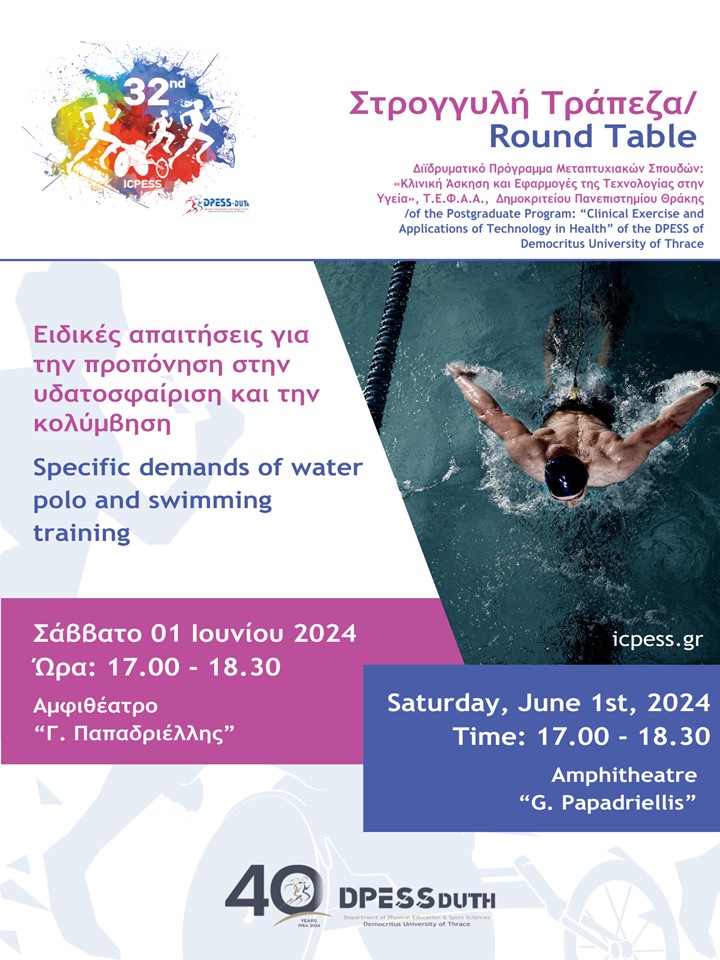
ROUND TABLE
Specific demands of water polo and swimming training
Chair: Gourgoulis Vassilios, Professor, D.P.E.S.S., Democritus University of Thrace
Toubekis Argyris, Professor, D.P.E.S.S., National and Kapodistrian University of Athens
Speakers:
Sleep patterns, recovery, and performance in aquatic sports athletes
Botonis Petros, Assistant Professor, D.P.E.S.S., National and Kapodistrian University of Athens
Training load evaluation for performance enhancement in aquatic sports
Toubekis Argyris, Professor, D.P.E.S.S., National and Kapodistrian University of Athens
Concurrent swimming and dryland resistance training for competitive swimmers
Arsoniadis Gavriil, PhD , D.P.E.S.S., National and Kapodistrian University of Athens
Evaluation of swimming technique
Gourgoulis Vassilios, Professor, D.P.E.S.S., Democritus University of Thrace
Abstract
Sleep patterns, recovery, and performance in aquatic sports athletes
Sufficient sleep quantity and quality is vital for health and recovery for all human beings and for athletes, particularly. A typical sleep is composed of periods of 90-min cycles divided into periods of non-rapid eye movement (NREM) and rapid eye movement (REM) sleep. Recent recommendations suggest that athletes should obtain 9-10 h of total sleep to cope with the increased need for recovery. To date, the studies which have used objective (e.g., actigraphy) sleep measures (time in bed, wake-up time, total time in bed, total sleep time, sleep efficiency, and wakes after sleep onset) suggest that athletes receive less sleep quantity than recommended. Besides the inadequate sleep duration, they present poor sleep efficiency and increased number of awakenings during the night. Training schedule and increased training load appear to be crucial factors jeopardizing the sleep of athletes participating in aquatic sports. In fact, training schedules requiring early morning trainings (<6 a.m.) and increased training volume and/or intensity have been linked with poor sleep, decreased subjective recovery the following day and likely with reduced endurance performance. In this direction, a growing number of studies in general and athletic population have shown that sleep deficit is associated with immunosuppression and increased risk of illness. Based on the abovementioned research findings, aquatic sports athletes and the coaching staff should be aware of the adverse effects of sleep loss on recovery and performance. The adoption of effective sleep strategies is necessary for the improvement of wellbeing, performance, and overall health of the athletes.
Training load evaluation for performance enhancement in aquatic sports
Athletes in aquatic sports participate in daily in-water training that induces substantial psychobiological load. The last is manipulated by the coach and considering the advice and support of the scientific staff. The external load planned for each athlete can be easily evaluated, however, the estimation of the individual internal load requires specific knowledge. In this context, the continuous heart rate recordings, the blood lactate concentration and the use of specifically designed sensors may be used for the quantification of the individual internal load. Additional information may be gained by recording the well-being status and sleep quality of the athletes. Besides this information, the product of the rating of perceived exertion with the training duration may be easily used in all aquatic sports for internal training load estimation. A systematic recording and subsequent control of training load is critical for the planning appropriate variation and periodization of the training stimulus during a mesocyle, or longer training periods. This information helps in the achievement of the best performance on a specific period of the year, while preventing occurrence of any immune system dysfunction or injury. Increased training load 4-8 weeks and an appropriate decrement 2-3 weeks prior to the main competition seem to be successful for competitive swimmers. A similar approach may be used for water polo players before internation tournaments with a duration of 2-3 weeks. A systematic recording of the training load and the appropriate modifications are decisive for a successful performance in important competitions.
Concurrent swimming and dryland resistance training for competitive swimmers
Dryland resistance training is routinely applied by swimmers aiming to increase their propulsive force and swimming performance. Swimmers usually apply dryland training such as maximum strength (≥90% of 1 repetition maximum) or strength endurance (40-60% of 1 repetition maximum) 15 to 40 min prior to swimming training (endurance or maximum intensity training). Dryland maximum strength training that performed 30 min prior to endurance swimming training did not affect swimmers’ speed during 5×400-m swimming repetitions or the tethered swimming force compared to control condition (no dryland training). However, decrements in stroke length and increments in stroke rate was observed during the 5×400-m endurance training set. A dryland strength endurance training 20 min prior to maximum intensity swimming training reduced performance during sets of maximum swimming efforts (8×25-m, 4×50-m). Interestingly a maximum strength training did not affected performance in the same maximum intensity efforts. Despite the limitations of the training sessions sequence applied in a daily training, most swimmers regularly perform dryland and swimming training concurrently for a period of 6 to 12 weeks. It has been reported that swimmers’ performance was improved in distances of 50 to 400-m and maximum strength was increased following 6 to 12 weeks of concurrent swimming and dryland training. Swimmers may apply dryland strength endurance training following a maximum intensity swimming training or separate these sessions in different days to avoid acute performance decrements in sprint swimming performance. Nevertheless, a long-term concurrent application of dryland resistance training and swimming training on the same training unit seem to improve swimmers’ performance.
Evaluation of swimming technique
Effective technique is a determining factor not only for achieving high performance and maximizing physical abilities, but also for avoiding injuries. Especially in swimming, technique becomes even more important, as due to the high density of the water, the consequences of even small technical errors are magnified. Swimming propulsion is based on the relationship of propulsive and resistive forces which is reflected in the velocity of the body’s center of mass (CM). Because for the determination of the CM’s velocity expensive equipment and sophisticated computational procedures are required, hip velocity can be used as an alternative. When the hip velocity increases it means that the propulsive forces predominate, while when it decreases it means that the resistive forces predominate. By recording the swimmers’ movement with high-frequency underwater and aerial cameras, and then digitizing with specific software selected points on the body (e.g. hip, knee, ankle, etc.), it is possible to determine both hip velocity and the movement of joints and body parts and to detect possible technical mistakes, providing the necessary feedback to the swimmers and their coaches. The evaluation can concern both the swimming styles, as well as the corresponding starts and turns, where the speed of the underwater dolphins or the individual underwater phases is of particular importance.