



- This event has passed.
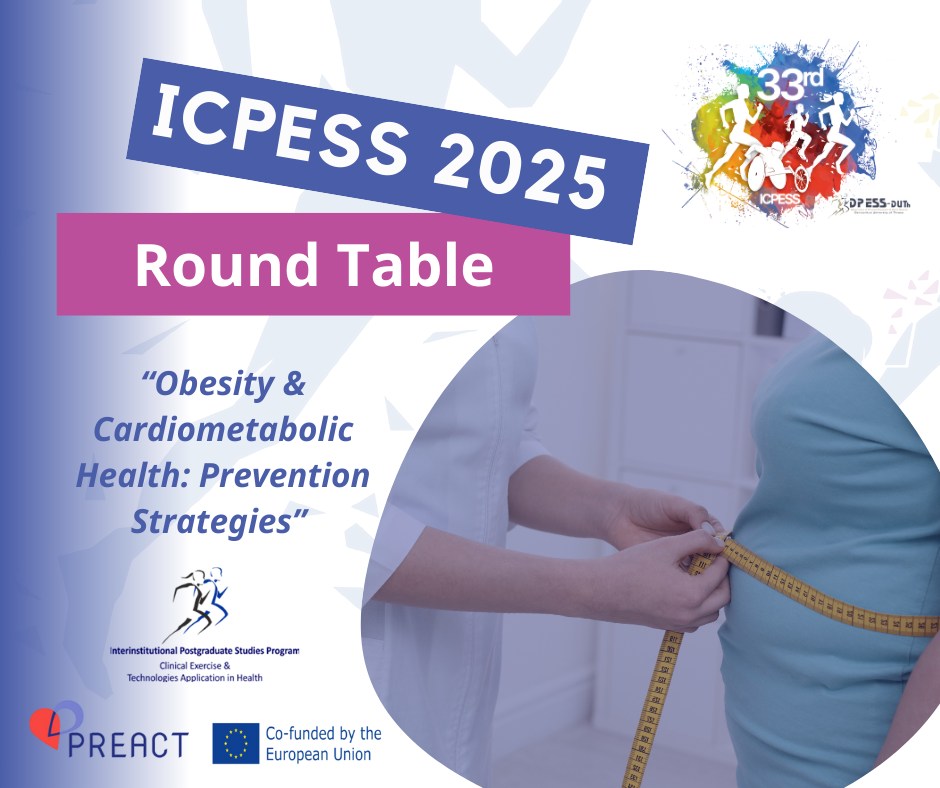
Obesity and Cardiometabolic Health: Prevention Strategies
With the support of the European Project entitled: ”Preventive Education and Actions for Cardiovascular Diseases and Diabetes Mellitus (PreAct)
Inter-Institutional Postgraduate Program: “Clinical Exercise and Applications of Technology in Health”
of the Department of Physical Education and Sport of the School of Physical Education and Sport Science of Democritus University of Thrace in collaboration with the National Center for Science Research “DEMOKRITOS” – The Institute of Informatics and Telecommunications (IIT)
Round Table
Obesity and Cardiometabolic Health: Prevention Strategies
Date: Sunday, May 25th, 2025
Time: 13.30 -15.30
Venue: Amphitheater “George Papadriellis”
Description:
It is widely accepted that obesity is a major public health problem worldwide as it is associated with the occurrence of cardiovascular risk factors and other metabolic diseases. This roundtable will present the latest data regarding its relationship with cardiometabolic health and will refer to prevention strategies, which should be implemented from childhood in order to be treated promptly and successfully.
Chairmen:
Savvas Tokmakidis, Emeritus Professor of Exercise Physiology, D.P.E.S.S., Democritus University of Thrace
Helen Douda, Professor, D.P.E.S.S., Democritus University of Thrace
Director of the Inter-institutional Postgraduate Program: “Clinical Exercise and Applications of Technology in Health”
Speakers:
Incidence and prevalence of risk factors for Cardiovascular Disease in Greece
Theodoros Xanthos, Professor of Physiology-Pathophysiology, Vice-Rector for Internationalization and Outreach of the University of West Attica, President of the Hellenic Society of Cardiopulmonary Resuscitation
Cardiovascular disease is one of the leading causes of morbidity and mortality in Greece. The prevalence of risk factors for cardiovascular disease in Greece is particularly high, which reinforces the need for targeted prevention and intervention strategies at national and local levels. Educating the public on healthy eating and physical activity, promoting public health policies that will reduce risk factors, and improving access to health services for early diagnosis and treatment are strategies that can contribute to reducing risk factors for cardiovascular disease and improving the quality of life of citizens.
Assessment of risk factors from childhood
Konstantinos Volaklis, Sport & Exercise Physiologist, Heart Rehabilitation Center, Cardio Clinic Augsburg / Center of Cardiac Prevention & Sports Medicine, Medical School, Technological University of Munich
Based on the recent strategies of primary prevention, the assessment of cardiovascular risk factors should be carried out relatively early, already in childhood, in order to significantly reduce the relative risk of cardiovascular disease. Important, among others, is the assessment of obesity indicators the measurement of blood pressure as well as the evaluation of physical activity levels, smoking habits and lipid profile. Based on relevant research, the early identification and treatment of cardiovascular risk factors significantly reduces the likelihood of disease occurrence and the resulting mortality.
Clinical Specifics in the Management of Type I Diabetes Mellitus
Evgenia Vlachou, Professor of the Department of Obstetrics of the School of Health and Welfare Sciences of the University of West Attica
Type 1 Diabetes Mellitus (T1DM) is a chronic autoimmune disease in which the pancreatic beta cells responsible for insulin production are destroyed. The lack of insulin leads to hyperglycemia and necessitates lifelong insulin therapy. Its management involves several clinical particularities, distinct from those of Type 2 Diabetes Mellitus, and requires continuous, multifaceted, and personalized care that combines insulin therapy, ongoing education, technological tools, and psychosocial support. Although obesity has traditionally been associated more with Type 2 Diabetes, in recent years it has increasingly been recognized as a significant aggravating factor in Type 1 Diabetes as well. The presence of obesity in individuals with T1DM can further complicate glycemic control, increase insulin resistance, and necessitate adjustments in insulin therapy. Moreover, it heightens the risk of cardiometabolic complications, adding to the already complex nature of the disease. Therefore, managing T1DM in combination with obesity requires an even more intensive and individualized approach, taking into account both glycemic needs and the factors that influence body weight, diet, and physical activity.
The Importance of Physical Exercise in the Perioperative Management of Morbid Obesity
Ilias Sdralis, General Surgeon, Director of the Morbid Obesity & Metabolic Diseases Surgery Clinic, Inter-Balkan Medical Center of Thessaloniki
Bariatric and metabolic surgery is one of the most effective interventions in the treatment of morbid obesity and related metabolic disorders. However, its long-term success depends largely on the adoption of a comprehensive therapeutic framework that includes lifestyle changes, with physical exercise playing a key role in both preoperative preparation and postoperative rehabilitation.
Pre-operative Physical Activity: The implementation of physical activity before surgery has multiple benefits for the patient:
- Improvement of cardiorespiratory fitness, which reduces the risk of complications during anesthesia and surgery.
- Increase in muscle mass and basal metabolism, which enhances postoperative recovery.
- Reduction of the inflammatory state of the body, which is associated with a better postoperative course.
- Psychological preparation and strengthening of adherence to the treatment plan.
Physical activity in this phase may include gentle aerobic exercise (such as walking or cycling), flexibility exercises, and light strengthening programs aimed at improving functionality and fitness.
Post-operative Physical Exercise: Incorporating exercise into the postoperative plan is crucial for:
- Maintaining weight loss and avoiding weight regain.
- Preventing loss of lean mass, which can occur due to rapid weight loss.
- Improving glycemic control, especially in patients with pre-existing type 2 diabetes or insulin resistance.
- Improving mobility, functional capacity, and quality of life.
- Enhancing mental well-being, by reducing stress levels and enhancing self-esteem.
Exercise should be progressive and individualized, considering the healing phase, physical condition and capabilities of each patient. The goal is to gradually transition from light physical activity to regular participation in organized exercise programs.
Integrated Therapeutic Approach: Bariatric surgery, when accompanied by systematic physical exercise, is not simply a method of weight loss, but acts as a starting point for a radical change in the patient’s metabolic and functional profile. Maintaining positive results depends largely on the integration of physical activity into everyday life, as an integral part of a new, healthy lifestyle.